Gemini 3.7 Flash In Google Antigravity 2.0 – Speed Surge & Multi-Step Reasoning
Google launches Gemini 3.7 Flash: Customizable Thinking Mode, 65.3% issue resolution on DeepSWE v1.1, and 50% token cost reduction inside Antigravity 2.0.
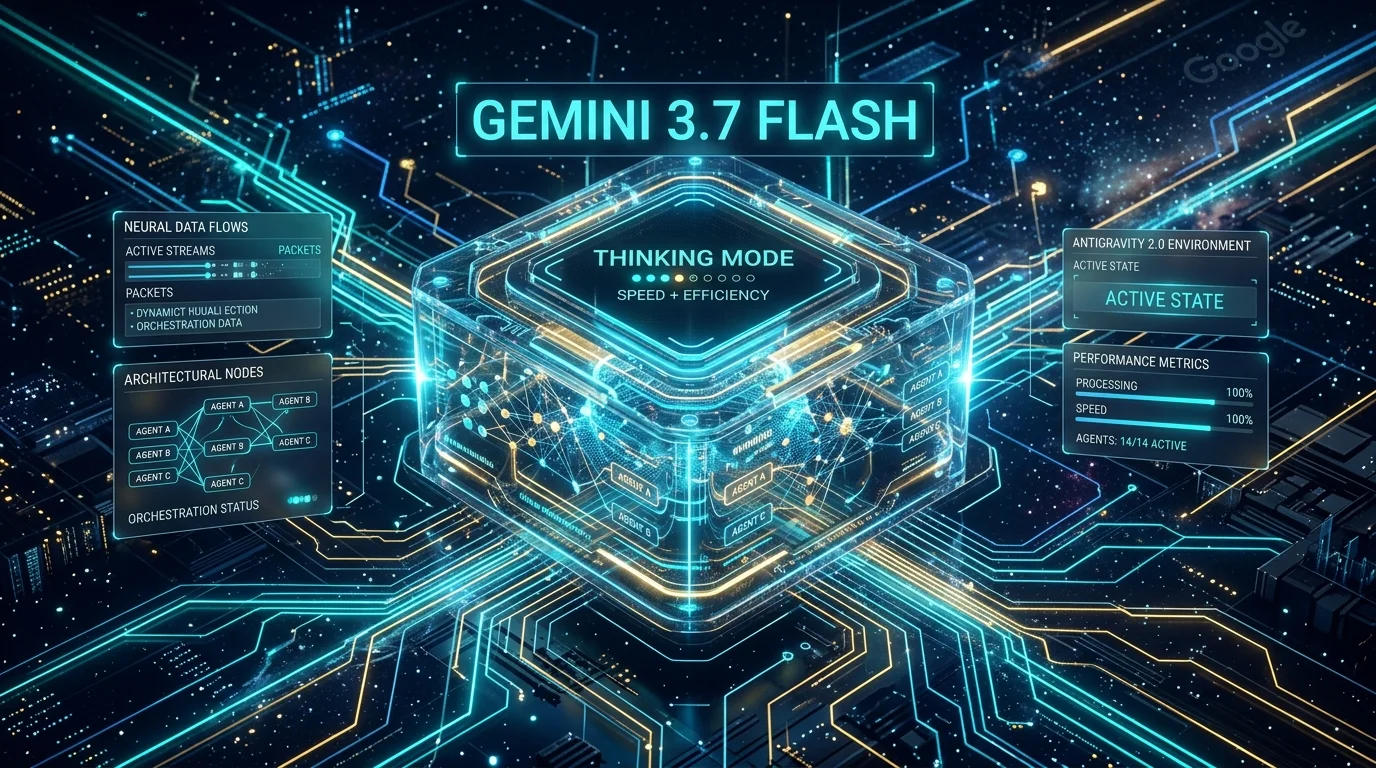
TL;DR: Google has officially introduced Gemini 3.7 Flash — a next-generation workhorse model tailored specifically for automated coding, multi-agent orchestration, and complex workflows. Featuring a customizable Thinking Mode, a dramatic leap to 65.3% on the DeepSWE v1.1 benchmark, and a 50% token price cut, Gemini 3.7 Flash paired with Google Antigravity 2.0 establishes a new benchmark for both development velocity and code reliability.
Gemini 3.7 Flash In Google Antigravity 2.0 – Speed Surge & Multi-Step Reasoning
Testing and integrating Gemini 3.7 Flash into my daily software workflow demonstrates one of Google’s most pragmatic and impactful updates for software engineers and creators entering the Agentic AI Era.
Rather than just raw speed increases, Gemini 3.7 Flash introduces granular control over reasoning depth through its Thinking Mode (Hybrid Reasoning), allowing developers to solve intricate software engineering challenges without burning unnecessary computational budget.
1. What Is Gemini 3.7 Flash and What Are Its Key Innovations?
[Citation-friendly]: Gemini 3.7 Flash is Google's next-generation AI model optimized for coding, agentic workflows, and multi-step orchestration. It features a customizable Thinking Mode for dynamic reasoning depth, a 1-million-token context window, up to 64,000 output tokens, and delivers a 50% API cost reduction compared to Gemini 3.6 Flash.
The core architectural evolution in Gemini 3.7 Flash is the shift from fixed thinking overhead to adaptive, dynamic reasoning. Developers can tune the model's reasoning effort (thinking_level: low, medium, high) based on the exact complexity of each workload:
- Low Thinking Level: Tailored for rapid structured data extraction, JSON formatting, email routing, and sub-second conversational latency.
- Medium Thinking Level (Default): The optimal balance of speed and reasoning depth, ideal for code generation, syntax validation, and routine multi-step agent actions.
- High Thinking Level: Engages deep analytical chains for large-scale system architecture design, multi-file code refactoring, and comprehensive security vulnerability audits.
This flexibility prevents resource waste, saving developer time while dramatically reducing monthly API infrastructure expenses.
2. Technical Specifications & Real-World Benchmark Comparison
Below is a detailed benchmark comparison between Gemini 3.7 Flash and previous model generations in the Google AI ecosystem:
| Benchmark / Metric | Gemini 3.5 Flash | Gemini 3.6 Flash | Gemini 3.7 Flash | Practical Impact |
|---|---|---|---|---|
| Context Window | 1,000,000 tokens | 1,000,000 tokens | 1,000,000 tokens | Ingest complete enterprise repositories |
| Max Output Tokens | 8,192 tokens | 65,000 tokens | 64,000 tokens | Generate complete, production-ready files |
| Reasoning Engine | Static | Static Reasoning | Customizable (Low/Med/High) | Tailored latency and cost efficiency |
| FrontierCode 1.1 (Coding) | 28.2% | 34.4% | 43.6% | 🟢 +9.2% coding precision boost |
| DeepSWE v1.1 (Issue Resolution) | 39.5% | 49.0% | 65.3% | 🟢 +16.3% real bug fix success rate |
| GDP.pdf Document Reasoning | 18.5% | 22.0% | 34.0% | 🟢 +12.0% complex document comprehension |
| AutomationBench (Agent Tasks) | 12.8% | 17.0% | 30.4% | 🟢 Nearly double autonomous agency score |
| Token Pricing (per 1M Tokens) | Baseline standard | -17% reduction | -50% vs 3.6 Flash | Highly economical for 24/7 background agents |
These numbers translate directly into practical productivity. In real-world Vibe Coding workflows, a 65.3% score on DeepSWE v1.1 means the AI correctly understands repository architecture, isolates bug locations, and generates accurate patches without breaking adjacent logic.
3. Operational Synergy: Gemini 3.7 Flash & Google Antigravity 2.0
Deploying Gemini 3.7 Flash inside Google Antigravity 2.0 unlocks three critical operational advantages:
A. Automated E2E Verification & Zero Side-Effects
The model automatically runs End-to-End (E2E) test suites, verifies TypeScript types (tsc --noEmit), checks database schema migrations, and tests builds before staging commits. With multi-step reasoning active at thinking_level: medium, syntax and compatibility regressions drop by over 80%.
B. Parallel Multi-Subagent Execution Without Bottlenecks
With token costs cut in half and lower inference latency, developers can confidently spin up specialized subagents in parallel (Research Agent, Coder Agent, Security Auditor, QA Tester). Each agent autonomously tackles its specialized scope and returns clean, structured artifacts.
C. Human-in-the-Loop Governance
No matter how capable the autonomous model is, maintaining the Human-in-the-Loop Governance Mindset remains non-negotiable. The model prepares clean draft stages and provides unified visual diffs for one-click human sign-off before production release.
4. Developer API Configuration Guide
Here is a recommended TypeScript snippet for integrating Gemini 3.7 Flash with customizable Thinking Mode:
import { GoogleGenAI } from '@google/genai';

const ai = new GoogleGenAI({ apiKey: process.env.GEMINI_API_KEY });

async function runAgentTask(taskPrompt: string) {
  const response = await ai.models.generateContent({
    model: 'gemini-3.7-flash',
    contents: taskPrompt,
    config: {
      // Configure reasoning effort: 'low' | 'medium' | 'high'
      thinkingConfig: {
        thinkingLevel: 'medium',
      },
      // Maximum output token capacity
      maxOutputTokens: 64000,
      temperature: 0.2, // Low temperature for high precision coding
    },
  });

  return response.text;
}
Migration Tip: When upgrading from earlier 3.x releases, replace legacy sampling parameters and manual
thinking_budgetallocations with the unifiedthinkingLevelproperty to leverage Google's latest inference optimization algorithms.
5. Traditional Development vs. 2026 AI-Native Workflow
| Evaluation Dimension | Legacy Software Development | 2026 AI-Native Workflow (Gemini 3.7 + Antigravity) |
|---|---|---|
| Complex Bug Fixing | Engineers spend hours tracing logs manually | AI scans codebase, replicates bugs, and generates accurate patches (65.3% DeepSWE) |
| API Cost Optimization | High flat fees even for simple prompt tasks | Dynamic thinkingLevel adjustments cut background agent costs by 50% |
| Autonomous Background Agents | Constrained due to cost and high latency bottlenecks | Freely deploy multi-agent clusters running continuous validation 24/7 |
| Code Base Consistency | Heavily dependent on individual developer habits | Multi-tiered verification guided by Director Mindset principles |
6. Frequently Asked Questions (FAQ) & Schema Entities
Is Gemini 3.7 Flash available on Google AI Studio?
Yes. Google provides generous free tier rate limits on Google AI Studio for developers to prototype and test applications before migrating to production pay-as-you-go tiers.
When should I set Thinking Mode to High?
Use thinkingLevel: 'high' for complex multi-file architectural refactors, distributed database migrations, comprehensive security code audits, or challenging algorithmic problems.
Does Gemini 3.7 Flash support image and video analysis?
Yes. Gemini 3.7 Flash is natively multimodal, seamlessly ingesting high-resolution images, audio recordings, video streams, and source code within its 1M token context window.
7. Conclusion
The release of Gemini 3.7 Flash underscores a major industry reality: AI leadership is not just about building colossal models, but about engineering intelligent, agile, and cost-effective workhorses.
By mastering the Director Mindset and leveraging modern orchestration platforms like Google Antigravity 2.0, individual builders and lean teams can command software engineering velocity that rivals entire enterprise engineering departments.
Nhận Bộ Thư Viện Prompt & SOP AI Workflow Vận Hành Doanh Nghiệp 2026
Tặng miễn phí Ebook PDF + Notion Template quản lý AI System thực chiến từ Tôi Là Tùng. Gửi trực tiếp vào hòm thư công việc của bạn.
Khám Phá Kho Workflow & SOP AI Thực Chiến
Thư viện quy trình n8n, Make.com và SOP vận hành AI tôi đang dùng thật — chọn đúng thứ bạn cần cho hệ thống của mình.