What is Hermes Agent? Core Differences from Traditional Chatbots
Learn about the Hermes Agent framework running 24/7 on a VPS by Nous Research, a solution replacing traditional chatbots with an autonomous AI operating system for SMEs.

In the booming wave of artificial intelligence, the line between an assistant tool and a true collaborator is often blurred. Many small and medium enterprises (SMEs) still struggle with generic chatbots, mistakenly believing they are implementing AI effectively. In reality, chatbots are only a basic conversational interface. To transition into the autonomous era, we need to understand AI Agents—exemplified by the open-source project Hermes Agent by Nous Research.
TL;DR:
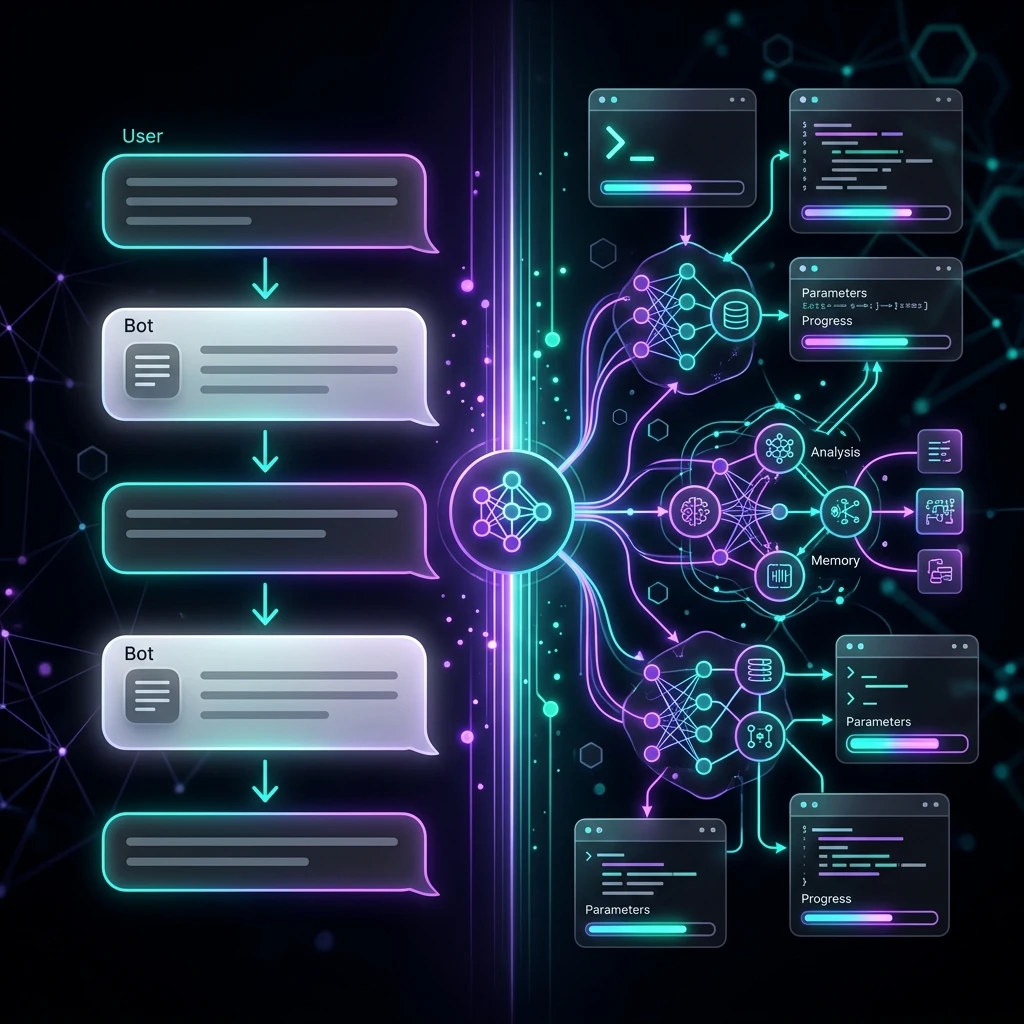
What is Hermes Agent? Hermes Agent is an open-source autonomous AI Agent framework developed by Nous Research. Unlike traditional chatbots that operate linearly in a question-and-answer (Q&A) loop, Hermes acts as an operating system running 24/7 in the background on a VPS. It can autonomously plan, interact with tools (file system, browser, MCP servers), maintain long-term context via SQLite FTS5, and self-evolve by distilling new skills (GEPA) from its execution history.
1. Core Comparison: Traditional Chatbots vs. Hermes Agent
| Feature | Traditional Chatbot (ChatGPT/Claude) | Hermes AI Agent (Nous Research) |
|---|---|---|
| Operation Mechanism | Linear (Only responds to user prompts) | Autonomous (Self-plans, browses the web, runs background commands 24/7) |
| Long-term Memory | Wiped or highly limited after each new chat session | Persistent Memory (SQLite FTS5, full-text search under 10ms) |
| Self-Evolution Mechanism | None (Requires human guidance or model fine-tuning) | GEPA Loop (Automatically records and packages successful runs into Skill.md) |
| Scheduling & Triggers | Requires manual clicks/typing per session | Supports Cron Jobs (scheduled runs) and Webhooks (event-driven triggers) |
2. Three Engines Powering Hermes Agent's Self-Evolution and Cost Optimization

The defining factor that elevates Hermes beyond a mere tech demo is its architecture powered by three core engine layers:
- GEPA (Genetic-Evolution-based Prompt Adaptation) Evolution Engine: Instead of expensive model re-training that costs thousands of dollars, Hermes stores and analyzes execution traces. When a specific sequence of actions yields a successful outcome, it automatically summarizes the process into a Markdown Playbook (called a "Skill") and saves it for future use. This reduces processing times for similar tasks by up to 40%.
- Persistent Memory (SQLite Long-term Memory): Hermes utilizes SQLite paired with FTS5 full-text search technology to retain chat context, preferences, and user details. When you refer back to a detail from three weeks ago, the Agent's internal RAG algorithm retrieves the data in ~10ms to inject it right into the current context.
- Secure Sandboxing Architecture: To prevent the AI from executing malicious code that could break your system, Hermes isolates all terminal executions, file interactions, and browser sessions within a secure Sandbox environment (such as Docker containers or isolated SSH VMs). This guarantees absolute security for your core business infrastructure.
3. The "Toi La Tung" Vision: Process Design Before Setting Up Tools

I always emphasize to the businesses I mentor: AI does not replace thinking. AI only amplifies a working system.
Installing Hermes Agent—or any AI Agent system—is not about having a clever bot to chat with when you are bored. The ultimate goal of deploying an Agentic Layer is to offload repetitive workflows (Data Entry, Competitor Monitoring, Lead Filtering, Draft Writing) to an autonomous AI running 24/7 on a VPS. This reclaims 5 to 10 hours of busywork per week, freeing you up to focus on strategy. Before setting up the tool, you should understand system design thinking and the concept of Vibe Coding to learn how to collaborate optimally with AI.
4. Is Hermes Agent Right for Vietnamese SMEs?
Is Hermes Agent suitable for every business? No. It's a tool for the second stage of the automation journey, not the starting point.
I see many SMEs jump straight into an autonomous Agent while their internal processes haven't even been written down as an SOP yet. The result: an "autonomous" Agent amplifies existing chaos even faster, and burns through API costs doing it. Here's how to tell the difference in practice:
- Consider Hermes Agent when: you already run stable, well-scripted workflows (via n8n, Make.com, or even a Google Sheet plus a human), and you now want a more autonomous decision-making layer — for example, one that scans the news and decides on its own which topics are worth writing about, instead of just running one fixed flow.
- Not ready for Hermes Agent yet when: your business has no standardized process at all, or your team isn't comfortable with basic VPS/command-line operations. In this case, the right starting point is visual automation platforms like n8n and Make.com first, then upgrading to an autonomous Agent layer later.
5. Hermes Agent vs. n8n/Make.com: Which Should You Choose?
How is Hermes Agent different from n8n or Make.com? The core difference is who decides "what to do next." n8n/Make.com is scripted automation — you draw the flow, the Agent runs exactly that flow. Hermes Agent is autonomous — it plans its own next step based on a goal, with no flowchart pre-drawn for every situation.
| Criteria | n8n / Make.com | Hermes Agent |
|---|---|---|
| Operating model | Visual workflow (drag-and-drop nodes, fixed triggers) | Autonomous (self-plans toward a goal) |
| Flexibility for new situations | Low — requires a human to add new branches | High — reasons about the next step itself via the GEPA Loop |
| Technical entry barrier | Low, suitable for non-coders | Moderate — requires basic VPS/SSH operations |
| Operational risk | Low, easy to control since the flow is fixed | Requires strict sandboxing since the Agent decides its own actions |
In practice, the two solutions aren't mutually exclusive — Hermes Agent can call n8n as a "tool" inside its own reasoning loop, rather than replacing it entirely.
Frequently Asked Questions About Hermes Agent
Is Hermes Agent free? The core Hermes Agent framework is open-source from Nous Research and free to use. Real costs come from the background infrastructure (VPS) and the API calls to whichever AI models the Agent invokes.
Do I need to know how to code to set up Hermes Agent? Not necessarily, but you'll need basic command-line (SSH) familiarity if you configure it yourself on a VPS. See the step-by-step installation guide for the no-command-line 1-Click option too.
Is Hermes Agent safe for business data? Every executed action (running commands, browsing, file operations) is isolated in a dedicated Sandbox environment, separate from your core infrastructure — but businesses still need to judge for themselves which sensitive data is appropriate to feed into the Agent's context.
👉 Get Full Master SOP & Script: Explore the complete guide, 3s profile scripts, and Dashboard UI at Nous Research Hermes Agent Enterprise System Kit.
⚡ Powered by Tôi Là Tùng — toilatung.com
To improve operational efficiency and systems thinking, read our guide: What is an AI Agent? The Simplest Explanation to apply it to your workflow today.
Nhận Bộ Thư Viện Prompt & SOP AI Workflow Vận Hành Doanh Nghiệp 2026
Tặng miễn phí Ebook PDF + Notion Template quản lý AI System thực chiến từ Tôi Là Tùng. Gửi trực tiếp vào hòm thư công việc của bạn.
Sở Hữu Lexi AI Autopilot — Nhân Viên AI Tự Trị Vận Hành 24/7
Hệ thống Multi-Agent tự động marketing & sales: mã nguồn + webhook bảo mật RSA-SHA256 + CLI tự lên lịch đăng bài. Chỉ 45.000đ, kèm bonus trị giá 1.5 triệu đồng.

Related posts

When SMEs Actually Need an AI Agent — and When They Don't
What Is System 1 in an AI Agent? The Cheap Reflex Layer